
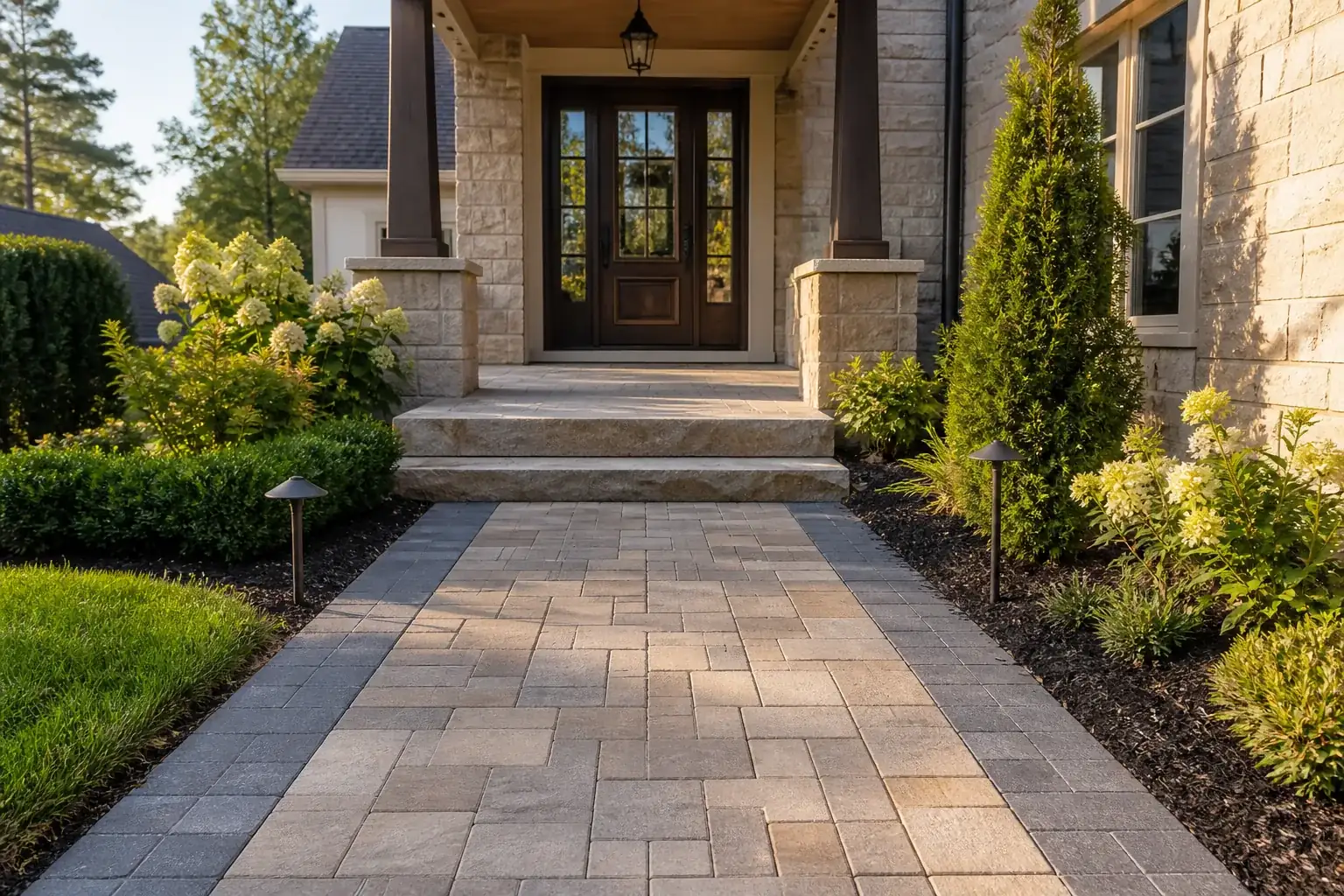
Walkways and Steps People Use Without Thinking About Them
The path to your front door is the first thing every guest touches and the last thing most contractors take seriously. Steps especially: uneven risers are the leading cause of falls on residential property, and they are entirely a build decision.
What is included
Every walkway and step job includes
- Route planning based on where people already cut across the lawn
- Consistent riser height across every step in a flight, within a quarter inch
- Tread depth that fits a real stride, with positive drainage on every tread
- Compacted base under walkway and step footings, below frost depth where required
- Solid step construction on block or poured footing, not stacked on sand
- Optional low-voltage lighting sleeved in before the base goes down
What it costs
Walkways typically run $15 to $38 per square foot installed. Steps are priced per step rather than per square foot, from $180 to $600 each depending on material, width and how much footing they need. Lighting is quoted separately.
Materials
Choosing what goes on top
All of these work. They differ in cost, how they age, and how much labor the install takes. We will tell you which one actually fits your site rather than which one has the best margin.
Concrete pavers
Matches an adjoining patio or driveway, widest color range, straightforward to repair.
Natural stone treads
Full-depth bluestone or granite slabs for steps. Heavy, expensive, and the most durable thing you can stand on.
Flagstone
Irregular natural pieces for garden paths and informal routes. Set on a base for permanence, or on sand for a softer look that needs occasional resetting.
Precast step units
Manufactured tread and riser blocks. Fast, consistent, cost-effective, and available to match most paver lines.
Fixing an entry or path?
Get a written price for your walkway and step project
Send us the basics and you get a written price back. We reply within 2 hours in business hours, and no pressure on the call.
- Line-item written quote, not a single lump number
- Insured crews, verified before they are scheduled
- 12 years in business, 5-star rated
Free walkway and step quote
Takes about 20 seconds.
5-star rated · 12 years · Fully insured · All 50 states
How it goes
From first call to walkthrough
Walk the route with you
We check where the ground actually sheds water and where people already cut the corner. Both change the layout.
Rise and run worked out on paper first
Total elevation divided into equal risers before anything is dug. This is the step that gets skipped and the reason so many outdoor stairs feel wrong.
Build
Footings, base, treads, risers, then the walkway surface tying into them.
Walkthrough at night too
If lighting is part of it we come back after dark to aim the fixtures, because that is the only time you can actually judge them.
Questions
Questions we get about walkways & steps
How wide should a front walkway be?
Four feet lets two people walk side by side, which is what a main entry should do. Three feet works for a secondary path. Anything under thirty inches reads as a garden trail and people will step off it.
Why do my existing steps feel awkward?
Almost always inconsistent risers. Your body memorizes the first step height and expects it on all the rest. A half-inch variation is enough to cause a stumble. Every step in a flight should be within about a quarter inch of the others.
Can steps be built directly on gravel?
Treads and risers need to bear on something that does not move, which in freeze-thaw country means a footing below frost depth or a properly compacted base designed for it. Steps set straight onto sand will shift, and steps that shift become a trip hazard rather than a cosmetic problem.
Is lighting worth adding?
On steps, yes without much argument. Low-voltage fixtures let you see the tread edge, which is the entire safety issue. It is dramatically cheaper to run the sleeve before the base is compacted than to cut it in later.
Fixing an entry or path?
Tell us what you are building and where you are. You get a written, line-item quote with no obligation.