
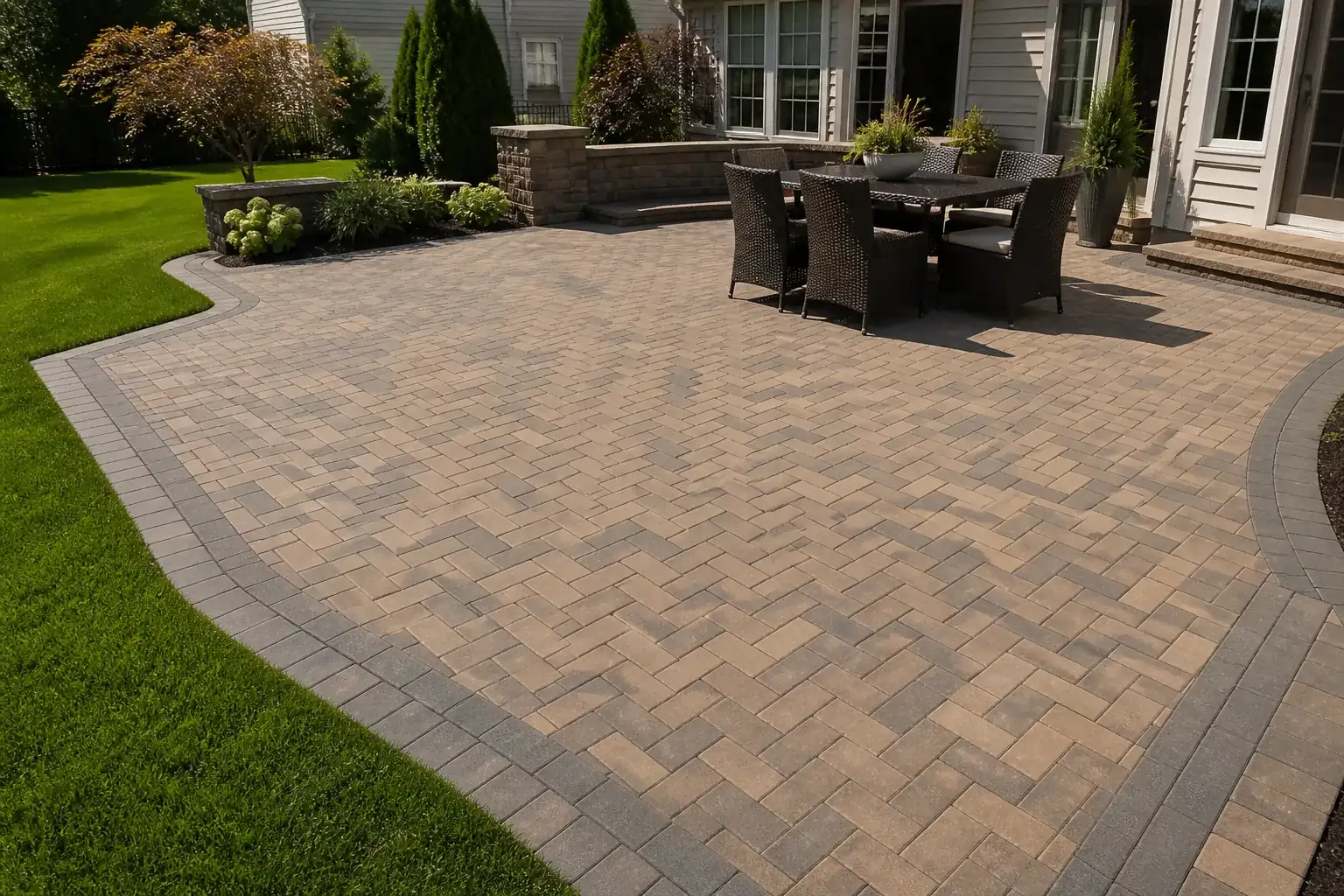
Paver Patios Built From the Base Up
Patios that sink, heave or turn into a weed farm nearly all failed underneath, built on four inches of whatever the crew had on the truck that day. We spec the base for your soil and freeze depth before anyone opens a paver catalog, then lay the pattern you picked.
What is included
Every paver patio job includes
- Layout and grade staking, with drainage planned away from the foundation
- Excavation to the depth your soil and frost line require, spoil hauled off
- Compacted aggregate base in lifts, plate-compacted at each stage
- Bedding sand screeded to a consistent depth, never used to fix bad grade
- Pavers cut on site for clean borders, soldier course around the perimeter
- Edge restraint spiked into base, polymeric sand swept and set
What it costs
Most paver patios land between $18 and $45 per square foot installed, driven by material choice, access for equipment, how much grade has to change, and whether steps or seat walls are in the plan. Your written quote breaks all of it out.
Materials
Choosing what goes on top
All of these work. They differ in cost, how they age, and how much labor the install takes. We will tell you which one actually fits your site rather than which one has the best margin.
Concrete pavers
The workhorse. Widest range of shapes and colors, most predictable cost, easy to source replacements years later.
Natural stone
Bluestone, travertine, flagstone. No two pieces alike, stays cooler underfoot, costs more in both material and labor because every piece is fitted.
Porcelain pavers
Dense, near-zero absorption, holds color. Excellent in freeze-thaw and around chlorine. Demands a very flat base and a saw that can handle it.
Clay brick
True brick pavers hold their color permanently because the color is the material, not a surface coat. Traditional look, narrow size range.
Planning a patio?
Get a written price for your paver patio project
Send us the basics and you get a written price back. We reply within 2 hours in business hours, and no pressure on the call.
- Line-item written quote, not a single lump number
- Insured crews, verified before they are scheduled
- 12 years in business, 5-star rated
Free paver patio quote
Takes about 20 seconds.
5-star rated · 12 years · Fully insured · All 50 states
How it goes
From first call to walkthrough
Talk through how you actually use the space
Where the sun is at 6pm, where the grill goes, how many people sit down at once. We draw the layout around how you will actually use it.
Design and a line-item price
You see the shape, the paver, the pattern and the full cost before committing to anything.
Build
Excavation, base, bedding, pavers, edge, joint sand. Typical patios run two to five days depending on size and access.
Walkthrough
We go over the work together, cover joint sand topping off in year one, and leave you the extra pavers.
Questions
Questions we get about paver patios
How deep does the base actually need to be?
For foot traffic in a mild climate, four to six inches of compacted aggregate is usually enough. In freeze-thaw regions or over clay soil that number goes to eight or ten, and clay often needs geotextile fabric under the stone so the base and subsoil do not mix. Anyone quoting the same base depth everywhere is quoting a guess.
Pavers or a poured concrete slab?
Concrete is cheaper up front and cracks eventually, because slabs on grade always do. Pavers move with the ground instead of fighting it, and a damaged section is lifted and reset rather than resurfaced. Over twenty years pavers usually cost less. Over three years concrete wins.
Will weeds grow through it?
Not from below if the base is right. What people see is windblown seed sprouting in the joints on top. Polymeric sand locks the joints and knocks that down hard, and a rinse plus a topping every few years keeps it that way.
How long does a patio take?
A straightforward 400 square foot patio is usually two to three days. Add time for heavy excavation, poor equipment access, retaining or seat walls, or steps.
Can you build over an existing concrete slab?
Sometimes. If the slab is sound, drains correctly and the added height does not bury a door threshold or a step, an overlay works and saves demolition. If the slab is cracked or holds water, it comes out. We tell you which one you have.
Planning a patio?
Tell us what you are building and where you are. You get a written, line-item quote with no obligation.