
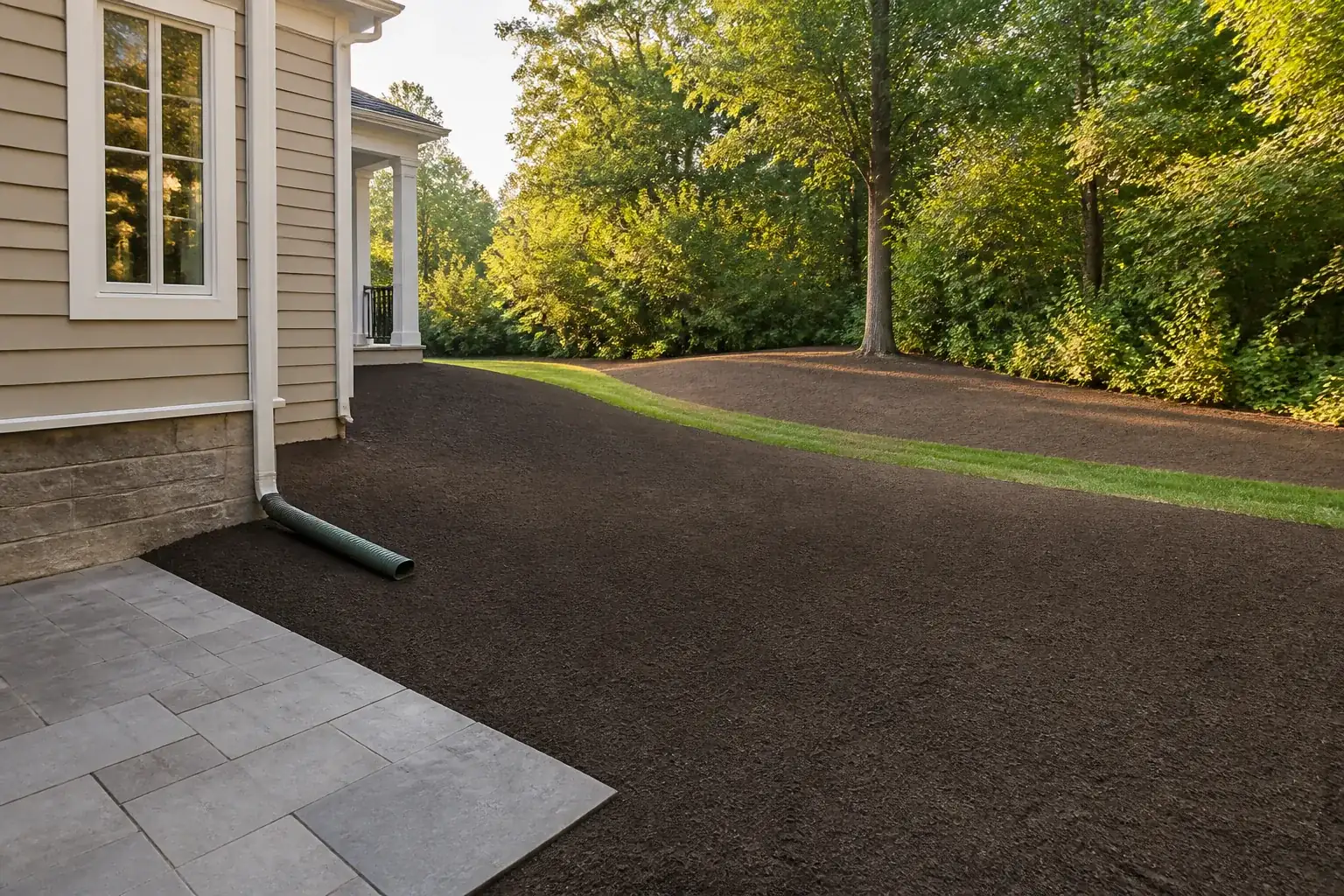
Water Goes Somewhere. Grading Decides Where.
Standing water in the yard, a wet basement wall, a patio that never dries, mulch washing across the drive after every storm. These are all the same problem: the ground is pointed the wrong way. Regrading fixes the cause. A pump only manages the symptom.
What is included
Every grading and drainage job includes
- Elevation shots across the property so the slope is measured, not eyeballed
- Positive fall away from the foundation on every side, to code minimums or better
- Rough grading to move the bulk, then finish grading to a surface ready for seed or sod
- Swales cut to carry surface water along a controlled path
- French drains, dry wells or catch basins where surface grading alone cannot do it
- Downspouts extended or buried so roof water is discharged well clear of the house
What it costs
A typical residential regrade runs $1,500 to $6,000 depending on how much soil has to move and how far equipment has to travel. French drains run $25 to $60 per linear foot, and dry wells $1,500 to $4,000 depending on the volume they have to hold. We price the grading and any drainage components as separate lines so you can see which is doing the work.
Materials
Choosing what goes on top
All of these work. They differ in cost, how they age, and how much labor the install takes. We will tell you which one actually fits your site rather than which one has the best margin.
Surface regrading
Reshaping the ground itself. Always the first thing to try, because it needs no components and nothing can clog.
Swale
A shallow shaped channel that moves water along a chosen route. Reads as part of the lawn and can be mowed.
French drain
Perforated pipe in washed stone, wrapped in filter fabric. For water already in the soil, or where surface fall cannot be achieved.
Dry well
A buried chamber that takes concentrated flow and lets it soak away. Sized to the roof or paved area feeding it. Used where there is nowhere to daylight a pipe.
Water in the wrong place?
Get a written price for your grading and drainage project
Send us the basics and you get a written price back. We reply within 2 hours in business hours, and no pressure on the call.
- Line-item written quote, not a single lump number
- Insured crews, verified before they are scheduled
- 12 years in business, 5-star rated
Free grading and drainage quote
Takes about 20 seconds.
5-star rated · 12 years · Fully insured · All 50 states
How it goes
From first call to walkthrough
See it wet if you can
Where the water actually goes during a storm beats any theory about where it should go. A short phone video taken while it is raining tells us more than a dry survey ever would.
Work out the fall
The drop from the foundation outward and across the yard decides everything. Slope is very hard to judge by eye and almost always worse than it looks, so we go through how to measure it properly.
Grade first, add components second
Reshaping the ground is cheaper and more durable than any pipe. Drains are added where grading alone cannot do the job, not instead of it.
Restore the surface
Finish grading, then seed, sod or the surface you chose, so the yard is usable again rather than left as bare dirt.
Questions
Questions we get about grading & drainage
How much slope does the ground need?
The common residential standard is about six inches of fall within the first ten feet out from the foundation, roughly a five percent grade. Across open lawn, two percent is the usual minimum for water to keep moving. Flatter than that and water sits, which is how you get the soft patch that never dries.
I have water in my basement. Is grading the fix?
It is the first thing to check and often the cheapest fix. A large share of wet basements are surface water arriving at the wall because the ground slopes toward the house or a downspout dumps beside the foundation. If the water is coming up through the slab rather than in at the walls, that is a different problem and grading will not solve it. We tell you which one you have before quoting.
French drain or regrading?
Regrade if you can. It costs less, has nothing to fail, and needs no maintenance. A French drain is the right answer when there is no room to create fall, when the water is already in the soil rather than on top of it, or when a neighboring property drains onto yours. Anyone who leads with a French drain before looking at slope is selling pipe.
Where does the water actually end up?
Somewhere legal and somewhere that is not your neighbor. Depending on the site that means daylighting to a lower point, a municipal storm connection where one is permitted, or a dry well sized to soak it away on your own property. Discharging onto adjoining land causes real disputes, so we plan the outlet before we plan anything else.
Will this ruin my lawn?
It disturbs it. Grading means equipment on the yard and soil being moved, so the affected area comes back as seed or sod, which is quoted as part of the job. Areas outside the work zone are protected, but we would rather set the expectation honestly than promise you will not notice.
Do I need a permit?
For simple regrading around a house, usually not. It changes when you are moving significant volumes of soil, working in a floodplain or wetland buffer, altering a drainage path that leaves your property, or connecting to a public storm system. We check your local rule before quoting rather than after.
Water in the wrong place?
Tell us what you are building and where you are. You get a written, line-item quote with no obligation.